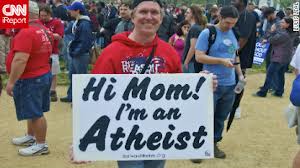
One-fifth of U.S. adults say they are not part of a traditional religious denomination, new data from the Pew Research Center show, evidence of an unprecedented reshuffling of Americans’ spiritual identities that is shaking up fields from charity to politics.
But despite their nickname, the “nones” are far from godless. Many pray, believe in God and have regular spiritual routines.
Their numbers have increased dramatically over the past two decades, according to the study released Tuesday. Sobre 19.6 percent of Americans say they are “nothing in particular,” agnostic or atheist, up from about 8 por ciento en 1990. One-third of adults under 30 say the same. Pew offered people a list of more than a dozen possible affiliations, including “Protestant,” “Catholic,” “something else” and “nothing in particular.”
Por primera vez, Pew also reported that the number of Americans identifying themselves as Protestant dipped below half, en 48 por ciento. But the United States is still very traditional when it comes to religion, con 79 percent of Americans identifying with an established faith group.
Experts have been tracking unaffiliated Americans since their numbers began rising, but new studies are adding details to the portrait.
Members can be found in all educational and income groups, but they skew heavily in one direction politically: 68 percent lean toward the Democratic Party. That makes the “nones,” at 24 por ciento, the largest Democratic faith constituency, with black Protestants at 16 percent and white mainline Protestants at 14 por ciento.
En comparación, white evangelicals make up 34 percent of the Republican base.
The study presents a stark map of how political and religious polarization have merged in recent decades. Congregations used to be a blend of political affiliations, but that’s generally not the case anymore. Sociologists have shown that Americans are more likely to pick their place of worship by their politics, not vice versa.
Some said the study and its data on younger generations forecast more polarization.
“We think it’s mostly a reaction to the religious right,"Dijo Harvard political scientist Robert Putnam, who has written at length about the decline in religious affiliation. “The best predictor of which people have moved into this category over the last 20 years is how they feel about religion and politics” aligning, particularly conservative politics and opposition to gay civil rights.
Americans have been fleeing institutions in general, Putnam wrote in his bestselling book “Bowling Alone,” about the decline of such institutions as hobby clubs and alumni associations. The culture is also more secular, with prayer in schools and the closing of businesses on Sundays fading along with traditional religious norms on marriage and sex.
For the presidential campaigns, the data reflect a simple fact on the ground. Three-quarters of unaffiliated voters voted for Barack Obama in 2008. Hoy, the unaffiliated break like this: 65 percent for Obama, 27 percent for Republican nominee Mitt Romney.
Longtime GOP political strategist and pollster Ed Goeas said the challenge for Republicans in reaching unaffiliated people is, bien, that they’re unaffiliated. Unattached to religious institutions, they’re hard to find. “They may be reachable message-wise, but not tactically,", Dijo.
But what does the political platform of this mammoth group of voters look like?
The nones are strongly liberal on social issues, including abortion and same-sex marriage, but no different from the public overall and the religiously affiliated on their preference for a smaller government providing fewer services.
If they have an issue, it’s that they don’t believe religion and politics should mix. Only a third of them say it matters if the president is a believer. Three-quarters of the affiliated think it matters.
This divide, dice religion and politics expert John Green, defines our culture.
“I suspect for these reasons that simmering cultural conflict for the last 30 o 40 years is likely to continue,” said Green, who advised Pew on the study.
This chasm isn’t news to religious or political leaders. Some political observers think that one of the reasons Obama and Romney have spoken minimally and in general terms about their faiths is that they haven’t wanted to alienate unaffiliated voters.
And many rising evangelical leaders have pushed hard to uncouple their faith from the GOP, de la Rev. Mark Batterson, who runs an evangelical megachurch on Capitol Hill popular with congressional staffers of both parties, to Focus on the Family’s new president, Jim Daly, who has said making Christianity less strident is his key mandate.
Lorna Stuart, 74, of Newport News, Va., describe a sí misma como "no tener religión" y dice que vota demócrata porque está muy a favor del derecho al aborto. A ella le gusta el hecho de que ella no suele escuchar a los candidatos demócratas a hablar de religión.
El analista retirado del ejército creció en una familia protestante de la línea principal activo en Massachusetts. Ella fue a grupos de jóvenes y la escuela dominical y cantaba en el coro de la iglesia. Ella crió a sus hijos en la Iglesia Metodista, pero dijo que en cualquier momento de su vida adulta, ella habría dicho a un encuestador que no se identifican con una etiqueta concreta.
A ella le gustaba la estructura social de la iglesia y de la idea de dar a sus hijos ", algo a rebelarse contra,", Pero ella piensa que la religión tradicional se centra demasiado en las reglas y el pecado y" cosas que realmente no se aplican a Dios,"Dijo en una entrevista el lunes.
Para el pasado 13 años, Stuart dice, ella ha estado en un grupo de meditación semanal y estudio formado por las personas que han "caído lejos" de algunas religiones y otros que están todavía activos.
"Somos mucho más que las iglesias nos dan el crédito para,", Dijo de la gente fuera de las grandes denominaciones. "Quiero decir que la gente. Somos seres espirituales en un viaje humano ".
Las creencias de los no afiliados no son fáciles de caracterizar, como muestra la encuesta de Pew. Los nones son mucho menos propensos a asistir a los servicios religiosos o decir la religión es importante en su vida. Pero 68 por ciento dicen que creen en Dios o en un espíritu universal, una quinta parte dicen que rezan todos los días y 5 ciento dice asistir a los servicios semanales de algún tipo.
Como la religión americana está en plena rotación, los expertos a menudo discuten si el país va a seguir el camino de Europa, con un laicismo más institucionalizada. Pero muchos de ellos señalan que la religión ha sido un concurrido mercado en los Estados Unidos y continúa reinventándose. Incluso si las estructuras y las instituciones y términos sabemos deslizamiento, Putnam dijo, es poco probable que el secularismo reemplazará la espiritualidad y la fe en este país.
"La religión en general en Estados Unidos ha sido sorprendentemente resistente. Eso es porque tenemos líderes realmente emprendedoras,", Dijo. “I think it would be bad to bet against the creativity of American religion.”
Fuente: WP

Sin comentarios
Comentarios para Uno de cada cinco estadounidenses reporta ninguna afiliación religiosa, estudio dice están cerradas.