
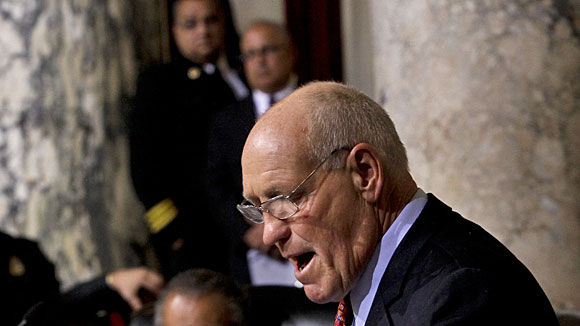
Councilman Bill Rosendahl, shown at a meeting last year, called one of the district changes an “outrageous case of gerrymandering.” (Anne Cusack / Los Angeles Times)
One district stretches deeper into the San Fernando Valley, another is removed from the Valley and a third separates Westchester and LAX. Los políticos, community advocates and neighborhood leaders complain.
Los Angeles’ Redistricting Commission unveiled its proposed boundary changes for City Council seats Wednesday, setting the stage for a series of pitched battles over neighborhood identity, ethnic clout and raw political power.
The maps sent one council district deeper into the San Fernando Valley, pulled another completely out of it and, in a third, employed what Councilman Bill Rosendahl called an “outrageous case of gerrymandering.”
Los políticos, community advocates and neighborhood leaders quickly criticized the maps, saying they did not reflect the public testimony and community desires expressed at a series of hearings in recent weeks. Koreatown activists, por ejemplo, complained that their request to keep their community in one district had been ignored.
Neighborhood volunteer Joe Barrett said members of his Sunland-Tujunga community would “flip out” over a plan to take it out of Councilman Paul Krekorian’s district. And Councilman Bernard C. Parks told a meeting of the 21-member commission that his South Los Angeles district has been treated like a junkyard, with commissioners “trying to find pieces” to fit into other districts.
Despite such comments, the commission voted 11 a 6 — the bare minimum to proceed — to begin circulating proposed new maps for the city’s 15 council districts to the public. Final boundaries must be approved by the commission en marzo 1 and then forwarded to the council for a vote.
Commission President Arturo Vargas, an appointee of Mayor Antonio Villaraigosa, told audience members in Van Nuys that the proposal was “a very rough draft” that would be vetted during seven upcoming hearings.
“This is definitely a work in progress, and I can assure everybody in the city that the final product of this commission will not be the same product,” dijo.
A redistricting panel is convened by city officials every 10 years to adjust council district boundaries to reflect changes in population and ethnic makeup. Part of that process is designed to ensure that Latinos, African Americans and other groups denied representation in the past have adequate opportunity to win office, según lo dispuesto en la Ley Federal de Derechos de Votación.
Nuevos datos de censo muestra Los Ángeles es ahora 48.5% Latino, 28.6% blanco, 11.3% Asia y 9.2% negro. Funcionarios de redistribución de distritos han estado tratando de asegurarse de que la ciudad cuenta con un mínimo de cinco escaños de los consejos que son muy latina y tres tienen concentraciones considerables de los afro-americanos - a pesar de que la población negro ha seguido disminuyendo.
Los cambios en los límites de distritos pueden potenciar o debilitar la influencia de los que se sientan los miembros del consejo - incluyendo aquellos que están buscando la reelección o un cargo más alto - y aumentar o disminuir el poder de voto de los grupos étnicos.
La propuesta de la comisión interrumpiría status quo político del Ayuntamiento en mayor o menor medida. Councilman Dennis Zine would live slightly outside his west San Fernando Valley district during his last year in office. Councilwoman Jan Perry’s district would be shifted south, causing her to lose much of downtown — a coveted and resurgent hub of business and development — while gaining Watts.
Perry’s downtown home would be outside her district. Councilman Tom LaBonge’s 4th District would see some of the most dramatic changes under the plan. His district would be extended from Silver Lake, where he lives, west to Bel-Air and then north to Encino. And Rosendahl would see much of Westchester taken over by Parks.
“Do I like what they’re trying to do to us? Por supuesto que no,” said Denny Schneider, who complained that LAX and adjacent Westchester were being placed in separate districts.
Similar complaints could be heard in Sherman Oaks, which has been represented by Krekorian and Councilman Paul Koretz.
“As much as I like Tom LaBonge, no one voted for him in the last election in Sherman Oaks,” said Richard Close, president of the Sherman Oaks Homeowners Assn., who served on the redistricting commission 10 Hace años.
The proposed maps were, in part, a response to demands from local business leaders for a sixth council district entirely or largely in the San Fernando Valley. But another factor may have been the fact that LaBonge’s appointee on the redistricting commission was in France — and has been participating via conference call.
“If you’re not there to throw a few elbows and stare people down while the people in the room are doing the work, it’s hard to get what you want,” said one commissioner, who spoke on condition of anonymity because panelists were not supposed to discuss their deliberations.
LaBonge said the proposed boundaries were disappointing.
Perry’s backers, mientras tanto, organized a Thursday rally to protest efforts to shift much of downtown into Eastside Councilman Jose Huizar’s district.
Tim Watkins, who lives near Watts and was on the redistricting commission a decade ago, warned the current boundary panel that the proposed changes would leave Perry’s district dominated by the city’s poor.
“You’re turning it into a district that really encompasses all of the people that are living in … desperation,” dijo.
The proposed district lines delighted Stuart Waldman, president of the Valley Industry and Commerce Assn., a group pushing for a sixth council seat in the San Fernando Valley.
“You listened to me. You listened to the neighborhood councils. You listened to the people of the San Fernando Valley,” he told the panel.
Fuente: LA. Tiempos

Sin comentarios
Comentarios para LA. panel de redistribución de distritos revela los límites del Consejo propuesto están cerradas.