
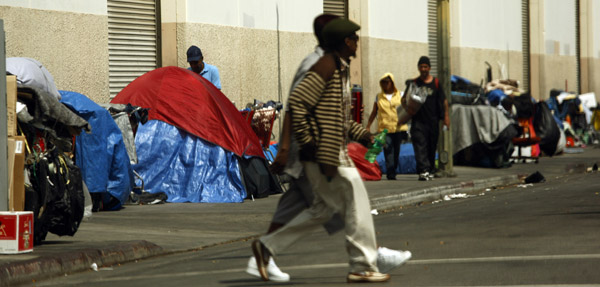
Los funcionarios públicos y los donantes privados se pasan $105 millones de dólares en más de un millar de habitantes de la calle crónicas. El cálculo del dinero es el producto más concreto aún de un ambicioso plan puesto en marcha hace dos años.
Habitantes de la calle más arraigadas del Condado de Los Ángeles constituyen sólo una cuarta parte de su más o menos 51,000 gente sin hogar. Pero los estudios han encontrado que representan una parte desproporcionada del gasto público, incluyendo en salas de emergencia de hospitales y cárceles.
El jueves, los funcionarios públicos y los donantes privados anunciarán que están gastando $105 millones para mover más de un millar de los casos más crónicos en viviendas permanentes, parte de un cambio radical en la forma en que el condado se ocupa de las personas sin hogar.
“There’s a momentum that has been building in Los Angeles to change the paradigm of how we address homelessness,” said county Supervisor Zev Yaroslavsky. “We are spending tens of millions of dollars a year … but I think what is clear is that we haven’t intelligently invested that money in the past. What we want to do is a more intelligent way to invest in the homeless, not to have temporary solutions.”
The shift to target the chronically homeless means more resources will go to people who have lived on the streets for at least a year and suffer from a serious physical, mental or substance abuse problem.
But some emergency housing providers complain that there will be less money to assist families, youths and others who may need only temporary shelter.
“My concern is by focusing all the resources on the few, we are leaving the many out in the cold,” said the Rev. Andy Bales, who heads the Union Rescue Mission on L.A.’s skid row.
Officials have been talking for years about a greater focus on the chronically homeless. Pero el $105 million — which combines public money already set aside to assist the homeless and low-income people with new donations from philanthropic and business groups — marks a major step in bringing it to fruition.
Sobre $88 million will go toward rental subsidies for 587 people over 15 años. In addition to using existing housing, $8.6 million will be used to develop 218 new units. The rest will be used to provide for counseling, tratamiento y otros servicios diseñados para mantener a la gente fuera de las calles.
El cálculo del dinero es el producto más concreto aún de un ambicioso plan puesto en marcha por los líderes empresariales y filantrópicos hace casi dos años con el objetivo de poner fin a largo plazo y la falta de vivienda veterano en el condado de 2016.
The Home for Good plan de, una iniciativa de United Way of Greater Los Angeles y la Cámara de Comercio de Los Angeles y alrededores, propone la reasignación de aproximadamente $230 millones de dólares en los recursos existentes cada año para pagar la vivienda de apoyo permanente, que incluye asesoramiento y tratamiento para ayudar a mantener a la gente fuera de las calles.
Esperan más dinero y recursos se dedicarán a los esfuerzos en los próximos años.
El enfoque fue promovido a nivel local por muy comentada sobre el Proyecto de la comarca 50 experiment and similar initiatives around the region, which have been praised not only for ending homelessness for many participants but also for saving municipalities money.
A county study found that Project 50, which began in late 2007 with the goal of housing the 50 most vulnerable, long-term homeless people on skid row, more than paid for itself, yielding a net savings of $238,700 over two years by cutting shelter, medical and jail costs.
Proponents of the approach argue that it is all the more important to spend strategically at a time when the state and federal governments are scaling back spending on affordable housing.
Jerry Newman, who co-chairs the Home for Good initiative, said that by prioritizing the most hard-core homeless for housing, “you take out the most costly portion of the issue, which will free up greater resources in the future.”
More than 100 community leaders and organizations — including the county Board of Supervisors, several cities and housing authorities — endorsed the Home for Good plan in its first year. In that period, más que 3,000 of the region’s long-term homeless and homeless veterans were placed in supportive housing, according to a report released in February.
A collaborative of 24 public and private contributors was formed to make the process more efficient. Members of the business and philanthropic communities, including the Conrad N. Hilton Foundation, committed $5 million to the effort, dijeron las autoridades. That money was then used to leverage $100 million in cash and services from the city and county of Los Angeles and from Pasadena.
En total, 30 nonprofits received awards ranging from $50,000 a $2.37 million to house the 1,018 personas.
Maria Cabildo, president of East L.A. Community Corp., said her organization was able with a single application to secure a grant of $2.3 million from the Los Angeles Housing Department to help build homes for 32 chronically homeless veterans in Boyle Heights and more than $6 million in subsidies through the Housing Authority of the City of Los Angeles to help cover their rents in the coming years.
With that support, the organization could break ground as soon as January, shaving at least a year off what can be a complicated and time-consuming process, Cabildo said.
Fuente: LA. Tiempos


Sin comentarios
Comentarios para LA. Condado de centrarse en los fondos crónicamente sin hogar están cerradas.