
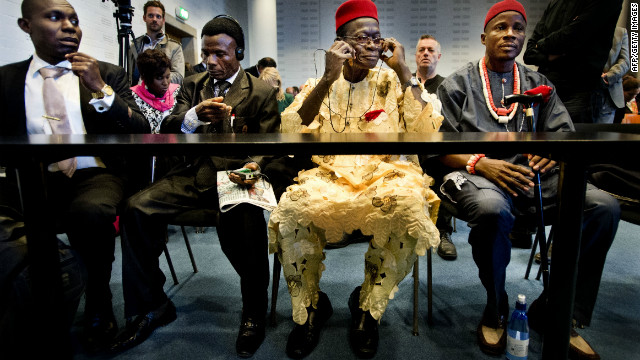
Four Nigerian farmers and the environmental group Friends of the Earth took oil giant Shell to court Thursday in the Netherlands to demand a proper cleanup and compensation for pollution in the Niger Delta.
The farmers want the Anglo-Dutch multinational to “clean up the oil pollution in their fields and fishponds” and make sure their pipelines are maintained and kept secure to prevent leaks in the future.
The civil case has been filed against the Nigerian subsidiary of Shell, the Shell Petroleum Development Company (SPDC), and its international headquarters in the Netherlands, Royal Dutch Shell.
Lire la suite: Ice floe forces Shell to call off Arctic drilling
Based on “years of oil pollution in three villages in the Niger Delta,” it could have “major legal consequences internationally,” the Dutch branch of Friends of the Earth, known locally as Milieudefensie, said in a statement ahead of the first hearing.
The three villages concerned are Goi, hit by a spill in 2004, Oruma, affected by a spill a year later, and Ikot Ada Udo, hit by various spills in 2007, according to Friends of the Earth.
Shell argues that it has cleaned up the spills to the satisfaction of the Nigerian authorities, and has no case to answer.
But Friends of the Earth says that oil pollution has had a devastating and continuing impact on vegetation, water supplies and local fishing ponds.
The campaign group says this is the first time a Dutch company has been brought before a court in the Netherlands over environmental damage caused abroad.
“It is also the first time that the headquarters of a multinational concern on the European continent has been summoned to appear in court for environmental or human rights violations in a developing country,” il dit.
Shell insists it is “committed to cleaning up all spills from its facilities” and blames saboteurs who steal oil from its pipelines for much of the environmental damage.
Lire la suite: Could it finally be springtime for Nigeria?
“The real tragedy of the Niger Delta is the widespread and continual criminal activity, including sabotage, theft and illegal refining, that causes the vast majority of oil spills,” Shell spokesman Jonathan French said in a statement Thursday.
“C'est cette criminalité qui toutes les organisations ayant un intérêt dans l'avenir du Nigeria devraient concentrer leurs efforts à mettre en évidence et d'adressage.”
Français a déclaré que Shell avait nettoyé trois fuites à trois endroits, à partir de 2004 à 2007, qui ont été causées par le sabotage. Selon la loi nigériane, les compagnies pétrolières ne sont pas tenus de payer une compensation pour les dommages causés par les déversements de sabotage, dit-il.
Le tribunal devrait entendre des deux côtés dans le cas jeudi et sera probablement un verdict plus tard cette année ou au début de 2013, Amis de la Terre ont dit.
“Avec optimisme, the legal route that Milieudefensie has chosen will ensure not only that four people in the Niger Delta have a better life but also increase the opportunity for thousands of their fellow citizens and millions of people worldwide who now often are without rights against powerful and sometimes unscrupulous multinationals,” campaign coordinator Geert Ritsema said.
The argument over the impact of oil production in the Niger Delta, which includes the Ogoniland region, is a long-running one.
The world’s third largest wetland, the Niger Delta is diverse and rich with mangroves and fish-rich waterways. But oil drilling has turned it into one of the most oil-polluted places on Earth, avec plus de 6,800 recorded oil spills, accounting for anywhere from 9 millions de 13 million barrels of oil spilled, according to activist groups.
Lire la suite: Chevron facing $18B judgment in Ecuador
Many residents make their livelihoods from fishing and depend on the polluted mangroves and creeks.
A report by the U.N. Environmental Program last year found that pollution from more than 50 years of oil operations in the Ogoniland region, by Shell and other companies, was more far-reaching than thought.
The assessment, commissioned by the Nigerian government and funded by Shell, concluded that restoration of the area could take up to 30 ans, cost $1 billion and become the largest cleanup operation in history.
“Control and maintenance of oilfield infrastructure in Ogoniland has been and remains inadequate: the Shell Petroleum Development Company’s own procedures have not been applied, créer des problèmes de santé et de sécurité publiques,” selon le rapport.
Shell a déjà accepté la responsabilité de deux déversements de pétrole dans l'Ogoniland en 2008 et 2009.
Source: CNN


Pas de commentaire
Commentaires pour Les agriculteurs poursuivent le géant pétrolier Shell sur la pollution du delta du Niger sont maintenant fermés.