
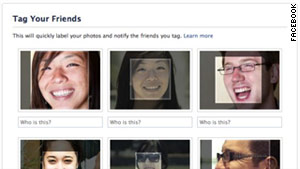
Facebook’s computer systems will soon be able to recognize familiar faces.
Facebook is making changes to the process for tagging friends in photos uploaded to the social network, the company announced on Tuesday.
Starting in a few weeks, the system will scan all images posted to Facebook and suggest the names of people who appear in the frame. El año pasado, Facebook began rolling the facial-recognition feature out to a test group.
Facebook’s more than 500 million users have been automatically included in the database, but the company is allowing each person to choose whether to be identified by toggling a pane in the account’s privacy settings.
The tool would still scan that person’s face and figure out who it is, but it won’t display that information. People can still manually tag friends.
French TV, radio programs slapped with social media restrictions
The news sparked a small brushfire of media hostility. Bloggers characterized the tool — and Facebook’s decision not to ask before including everyone — as unsettling while others urged readers to opt out.
Google recently decided not to release an application that would let someone snap a picture of a person’s face using a smartphone in order to find out who the subject is, Eric Schmidt, the search giant’s executive chairman and former CEO, said at a conference last week. Schmidt believed it to be the first time Google engineers had completed a project and decided to shutter it for privacy reasons, dijo.
The work on Google’s facial-recognition technology has not gone to waste. It’s used to preserve privacy by blurring faces in Google’s Street View mapping project, Hartmut Neven, the engineering director for image recognition, said in a recent interview.
When asked whether he would be frustrated if Facebook beat his team to releasing a face-recognition product, Neven said: “Let them get burned first. There would be some backlash.”
Photo-management software such as Google’s Picasa and Apple’s iPhoto provide a similar feature. They pore over a person’s snapshots in an attempt to group each person together by facial features. Google has not enabled this feature on the online version of its photo software, called Picasa Web Albums.
Limited to a small sampling of the few hundred photos on a person’s computer, these systems aren’t very accurate.
With the largest photo-sharing service in Facebook scanning millions of pictures daily, these algorithms are no doubt learning quickly. Más que 100 million photos per day are uploaded to Facebook, according to a company statement.
The face-scanning feature actually runs counter to Facebook CEO Mark Zuckerberg’s comments to reporters in November.
“Before people-tagging came out, I think most people would have said that the best way to figure out who’s in photos was to have some face-recognition algorithm,” dijo. “But it actually turns out that the best way is to just have people tagged.”
Some experts agree with Zuckerberg’s apparently outdated statements.
“Face technology will never work in gigantic-large databases,” said Ipplex CEO Orang Dialameh, quien ha trabajado con Neven en el pasado.
Sin embargo, “si se limita la base de datos — decir, Estoy tratando de reconocer a alguien en el 400 contactos que tengo en Facebook,” a continuación el análisis cara podría ser eficaz, dijo.
Los usuarios de Facebook que han instalado una aplicación llamada Photo Finder ya pueden tener caras en sus fotos escaneadas e identificados.
La aplicación de 3 años de edad, ha analizado más de 23 miles de millones de imágenes, dijo Gil Hirsch, el director general de Face.com, que desarrolla el servicio. Un portavoz Face.com no respondió de inmediato a una solicitud de comentarios sobre la competencia de Facebook.
Fuente: CNN


Sin comentarios
Comentarios para Facebook permite a los usuarios optar por el reconocimiento facial están cerradas.