
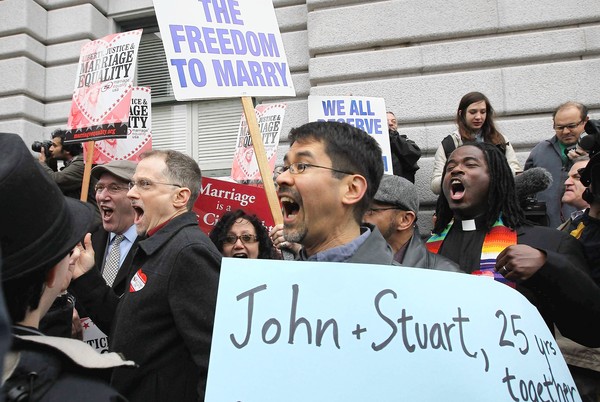
Reporting from San Francisco and Los Angeles — A federal appeals court has declared California’s 2008 voter-approved ban on same-sex marriage unconstitutional, concluding that the prohibition served no purpose other than to “lessen the status and human dignity of gays and lesbians.”
La 2-1 ruling by the U.S. 9th Circuit Court of Appeals was narrowly written to limit its scope to California’s borders and possibly even avoid review by the U.S. Corte Suprema de Justicia, expertos legales. Nonetheless, gay-rights advocates hailed Tuesday’s decision as historic, while supporters of Proposition 8 immediately vowed to appeal.
Instead of expanding the constitutional rights of gays and lesbians, the court based its decision on a 1996 EE.UU.. Supreme Court precedent that said a majority may not take away a minority’s rights without legitimate reasons.
“Proposición 8 operates with no apparent purpose but to impose on gays and lesbians, through the public law, a majority’s private disapproval of them and their relationships,” Judge Stephen Reinhardt wrote for the court.
The ruling won’t take effect immediately; supporters of Proposition 8 have two weeks to appeal to the circuit court and 90 days to file a petition for Supreme Court review.
Though divided on the constitutional question, the three-judge panel unanimously agreed that ProtectMarriage, the backers of Proposition 8, had the right or legal “standing” to appeal Chief U.S. District Judge Vaughn R. Walker’s 2010 ruling against the ballot measure.
The panel also unanimously rejected a challenge by ProtectMarriage that Walker’s ruling should be set aside because he failed to disclose that he was in a long term same-sex relationship. Walker, who has since retired, ruled after an unprecedented, two-week trial that examined the meaning of sexual orientation and the history of marriage and gay rights.
“It’s no surprise that the 9th Circuit’s decision is completely out of step with every other federal appellate and Supreme Court decision in American history on the subject of marriage,” said Andy Pugno, a lawyer for ProtectMarriage. “Ever since the beginning of this case, we’ve known that the battle to preserve traditional marriage will ultimately be won or lost not here, but rather in the U.S. Corte Suprema de Justicia.”
Sin embargo, otros abogados y juristas, dijo el 9 º Circuito podría tener la última palabra sobre la Proposición 8 debido a que el fallo era limitado, así intencionadamente a California, un estado donde los votantes quitaron una minoría de un derecho que ya existía y donde las justificaciones habituales para una prohibición del matrimonio entre personas del mismo sexo, la paternidad responsable y la procreación, ven socavados por las leyes de parejas de hecho.
Proposición 8 pasado como una enmienda constitucional que seis meses después de la Corte Suprema de California revocó una ley estatal que limita el matrimonio a un hombre y una mujer, y se estima que 18,000 parejas del mismo sexo casadas durante ese tiempo. La iniciativa también no afecta a los derechos de paternidad de gays y lesbianas, que están protegidos en virtud de otras leyes estatales.
“Esa formación jurídica no existe en la mayoría de los estados,” said University of Minnesota Law School professor Dale Carpenter, who has followed the case.
Loyola law professor Douglas NeJaime agreed, noting that Tuesday’s decision allows the U.S. Supreme Court to postpone a pronouncement on same-sex marriage until a more sweeping case comes along.
“The 9th Circuit decided the case in a way that would allow the Supreme Court to affirm without having to significantly expand on its existing jurisprudence and without having to rule on marriage for same-sex couples on a national scale,” NeJaime said.
ProtectMarriage could ask a larger panel of the 9th Circuit to review Tuesday’s ruling, which could keep the case in the circuit for another year. If the group went directly to the Supreme Court and won review, the high court could rule on the case next year.
ProtectMarriage has long said it wanted the high court to get the case as soon as possible, but its representative said Tuesday that the organization has yet to decide its next step.
In the opinion, Reinhardt drew close parallels between Proposition 8 y una 1992 Colorado initiative that barred the government from passing laws to protect the civil rights of gays and lesbians. Los EE.UU.. Corte Suprema de Justicia, in a decision written by Justice Anthony M. Kennedy, struck down Colorado’s law in 1996.
Calling Proposition 8 “remarkably similar” to the Colorado initiative, the 9th Circuit said both measures singled out one class of people and removed an existing right without serving any reasonable purpose.
“It is implausible to think that denying two men or two women the right to call themselves married could somehow bolster the stability of families headed by one man and one woman,” the court said.
David Boies, one of the lawyers for two same-sex couples who sued to overturn Proposition 8, said the ruling presented “the most difficult set of facts” possible for ProtectMarriage because the decision “so squarely fits” the high court’s precedent in Evans vs. Romer, the case that struck down the Colorado measure.
Despite the 9th Circuit’s attempt to limit its ruling, advocates for same-sex marriage celebrated it as a giant step for gay rights across the country.
“Esta es la primera vez que un tribunal federal de apelaciones ha dictaminado que la claridad igualdad en el matrimonio está constitucionalmente obligado,” Boies dijo.
Unirse a Reinhardt, un león liberal del 9 º Circuito designado por el ex presidente Jimmy Carter, era el juez Michael Daly Hawkins, un ex fiscal federal de Arizona y una persona nombrada por el ex presidente Bill Clinton.
Juez N. Randy Smith, un conservador nombrado por el presidente George W. Arbusto, disentido, argumentando que limitar el matrimonio a las parejas de distinto sexo podía justificarse sobre la base de que las parejas heterosexuales son las únicas parejas que pueden procrear naturalmente.
“La estructura de la familia de dos padres biológicos comprometidos - un hombre y una mujer - es la asociación óptima para la crianza de niños,” Smith escribió.
También señaló que los Estados pueden legítimamente prohibir la bigamia, incesto, bestialidad y otras relaciones sexuales condenados por la sociedad, así como imponer límites de edad para el matrimonio o exigir pruebas de enfermedades venéreas sin violar los derechos constitucionales.
Barry McDonald, un profesor de derecho constitucional en la Universidad de Pepperdine, llamada argumentos de Smith “muy razonable.” Considerando que el caso de Colorado prohibió gays de recibir todo tipo de protecciones contra la discriminación, Proposición 8 se limitaba al matrimonio, McDonald señaló.
“Va a ser más difícil hacer el caso de que los votantes de California fueron animados por la animosidad pura solos” al pasar la Proposición 8 “puesto que ya habían hecho tanto en dar a los gays y lesbianas todos los derechos del matrimonio,” McDonald dijo.
Both the majority opinion and the dissent appeared written largely for one justice: Justice Kennedy, who not only wrote the precedent that Tuesday’s ruling relied on but who is considered a swing vote on the high court, UC Irvine law professor Richard Hasen said.
“Just as Judge Reinhardt was smart and savvy in writing his analysis striking down Prop. 8 on the narrowest grounds possible, Judge Smith’s dissent is similarly crafted to be appealing to a swing justice,” Hasen said.
He said the majority ruling appeared to be aimed at Kennedy’s strong distaste for animus while the dissent appealed to his preference for judicial restraint.
At a news conference in Los Angeles, plaintiff Kris Perry appeared with her longtime partner and their twin teenage sons.
“Hoy, the 9th Circuit said to our family that we are equal under the law,” she said from a stage draped with American flags. Ahora, dijo, “we can see over the dark wall of discrimination.”
Fuente: LA. Tiempos

Sin comentarios
Comentarios para Tribunal Dividido rechaza la Propuesta 8 están cerradas.