
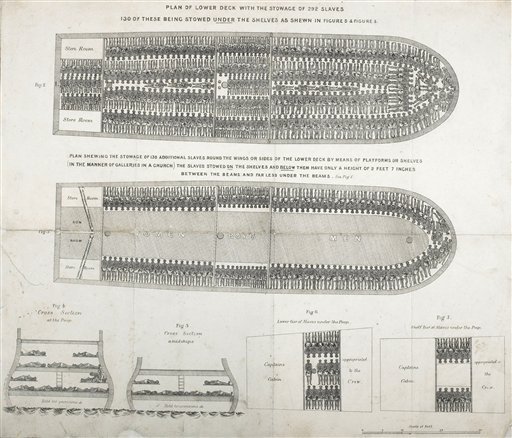
LONDRES - Una nueva base de datos lanzada Miércoles permite británicos curiosos sobre su historia familiar descubrir alguna información potencialmente incómoda – si sus antepasados poseían esclavos.
Investigadores de la Universidad College de Londres pasaron tres años recopilando una lista de búsqueda de miles de personas que han recibido una compensación por la pérdida de su “posesiones” cuando la propiedad de esclavos fue prohibido por Gran Bretaña en 1833.
Sobre 46,000 personas pagaron un total de 20 millones de libras – el equivalente de 40 por ciento de todo el gasto público anual en el momento – después de la liberación de los esclavos en las colonias británicas en el Caribe, Mauricio y el sur de África.
“Se trata de un enorme plan de rescate,” dijo Keith McClelland, un investigador asociado en el proyecto. “En términos relativos, es más grande que el rescate de los banqueros en los últimos años.”
Compensación por los propietarios de esclavos fue rechazada por algunos abolicionistas, quien argumentó que era inmoral, pero fue aprobado como el precio político de conseguir el 1833 proyecto de ley de abolición pasó.
La base de datos incluye detalles sobre la 3,000 dueños de esclavos compensados que vivían en Gran Bretaña – en lugar de sus colonias – e incluye los antepasados de varios políticos de hoy en día y los escritores Graham Greene y George Orwell. El verdadero nombre de Orwell era Eric Blair, y los fideicomisarios de su bisabuelo, Charles Blair, fueron pagados 4,442 libras por 218 esclavos en una plantación en Jamaica.
No todos los propietarios de esclavos eran ultra-ricos. De clase media británicos arriba y abajo del país se les pagaba una indemnización – evidencia, los investigadores dicen, de hasta qué punto los tentáculos de la esclavitud propagan a través de la sociedad.
Los premios van desde rico comerciante John Gladstone, father of 19th-century Prime Minister William Ewart Gladstone, who received more than 100,000 pounds in compensation for hundreds of slaves, to Jane Bayne, a Scottish doctor’s wife who received 84 libras por 10 slaves on a plantation in Jamaica. Even that modest settlement was more than the annual salary of a skilled worker at the time.
This is not the first online database to try to chronicle the trade that took more than 10 million Africans across the Atlantic to the Americas. Emory University in Atlanta has a site with information on 35,000 slave ship voyages, and the University of North Carolina at Greenboro has compiled online listings of slaves and slave-owners.
McClelland said the London project would expand understanding of how the legacy of slavery still affects Britain.
He said 10 percent of wealthy 19th-century Britons were directly connected to the slave trade, and its proceeds helped build railways, empresas, buildings and art collections that still exist today.
“You are talking about a very important component of the British economy from the 17th century onwards,” McClelland said.
Britain’s Parliament abolished the slave trade in 1807, but slavery itself was not outlawed in its colonies until 26 años más tarde. The United States followed in 1865 and Brazil in 1888.
En 2006, then-Prime Minister Tony Blair expressed “deep sorrow” for Britain’s role in the trans-Atlantic slave trade, though some felt that fell short of a full apology. The next year he said: “I have said we’re sorry and I say it again now.”
The research could give momentum to those who argue that reparations should be paid for slavery. Barbados and Jamaica have both set up commissions to study the possibility of suing Britain over the legacy of the slave trade.
Esther Stanford-Xosei of the Pan-African Reparations Coalition in Europe said the database was an important contribution to the debate over reparations, which she said should be as much cultural as financial.
“Reparations means to repair the harm- and there are not only economic harms or legacies,” dijo.
“This research is in itself an aspect of educational reparations because it is telling a narrative and a history that is not mainstream, that is not included in the curriculum. It shows how widespread the benefits of African chattel enslavements were – and not just to the elites.”
Fuente: Herald

Sin comentarios
Comentarios para Base de datos permite a los británicos a encontrar antepasados esclavistas están cerradas.