CHARLOTTE, N.C. — When Parti démocratique leaders began planning the 2012 national convention, they vowed to put it on without the help of corporations, lobbyists and political action committees who have traditionally helped finance the multi-day extravaganzas, relying instead on small donations to pay for a “people’s convention.”
But corporate money maintained a persistent presence here this week.
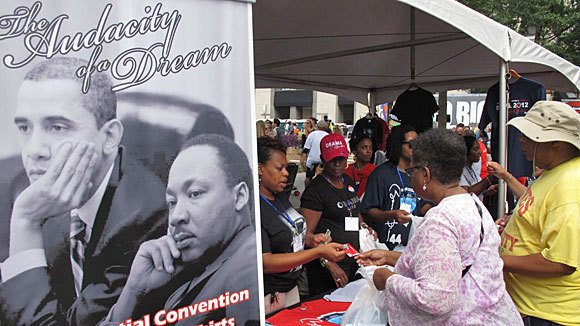
“Thank you to all of our corporate sponsors,” read a large white banner at the Carolina Fest street fair that kicked off the convention.
PHOTOS: 2012 Convention Nationale Démocratique
It listed 16 companies, y compris AT&T, Bank of America, Coca-Cola and United Health Group; they were among those who together gave at least $11 million to a nonprofit organization called New American City set up by convention organizers to handle the street festival, media welcome party and delegate receptions.
Unlike a separate committee that aimed to raise $37 million for the production of the convention itself, New American City was allowed to accept direct corporate, PAC and lobbyist money.
“We told the [host] comité, from the beginning, that we wanted to participate in any way that we could,” said Peter Covington, vice chairman of the global law and lobbying firm McGuire Woods, which sponsored both Carolina Fest and a kickoff party for the media held at a sprawling music venue.
“We really did step up to make sure that Charlotte showed well,” dit-il. “It was our commitment to making it succeed, without regard to the political part.”
The convention committee itself also had corporate backing. Although the companies could not give directly to it, ils pourraient faire des contributions en nature - Xerox, par exemple, a donné l'impression et des fournitures d'une valeur de $150,000, selon le Charlotte Observer.
Fonctionnaires démocratiques insisté ils ont rencontré leur niveau de financement de la convention sans l'aide des intérêts particuliers auto-infligée, faisant valoir que les activités mis sur pied par la nouvelle ville américaine étaient séparés de la convention elle-même.
“Même si c'était très difficile - il a rendu plus difficile de répondre à nos besoins budgétaires et a pris un peu plus longtemps que n'importe quel d'entre nous étaient à l'aise avec - nous sommes si fiers que nous nous sommes assurés que c'était la communauté la plus ouverte et accessible et inclusif convention orientée dans l'histoire,” Démocratique présidente du Comité national Debbie Wasserman Schultz said as delegates buzzed around her in the Charlotte Convention Center on Wednesday. “People know this is a convention they own, that they have a piece of this campaign.”
Political parties are banned from accepting corporate money for their quadrennial gatherings, a Watergate-era reform instituted after a scandal surrounding the 1972 Convention républicaine, when the International Telephone and Telegraph Corp. offered $400,000 to help bring the event to San Diego at the same time the company was trying to get the Nixon administration to drop antitrust charges.
Depuis 1976, the two major parties have received public funds to put on the events — this year, $17.7 million each.
But neither sticks to that budget, thanks to a loophole created by the Commission électorale fédérale dans 1977, when it decided that the conventions could be produced in part through unlimited donations to a local host committee.
That’s brought in a gusher of cash for increasingly lavish events. Four years ago, organizations such as corporations and unions gave 86% of the $61 million Democrats raised for their convention in Denver.
“We have gone entirely full circle,” said Craig Holman, legislative representative for the campaign-finance watchdog group Public Citizen.
Holman credited Democratic convention organizers for their “noble efforts” cette année, but said new legislation was required to truly keep special interests at bay.
Charlotte leaders did not know about the rules when the city was chosen to host the event. Host committee co-chair Jim Rogers, chief executive of Duke Energy, had already secured commitments of around $11 million from locally based companies to help pay for the convention before the party announced that corporate, lobbyist and PAC money would not be accepted, said Rogers spokesman Tom Williams.
Those companies donated instead to New American City, along with other corporations later recruited by Rogers.
Source: L.A. Times

Pas de commentaire
Commentaires pour Une convention sans commanditaires? sont maintenant fermés.