
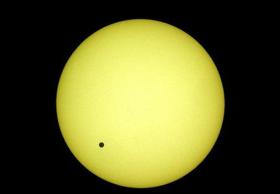
Thousands of scientists and sky watchers around the world have made detailed plans to monitor today’s transit of Venus across the sun, but chances are that word of the last-in-a-lifetime event is just now sinking in for millions of just plain folks — so what’s the big deal? And what’s the best way to watch the transit?
We’ve had dozens of stories about Venus’ day in the sun over the past few weeks, but for those of you who are just tuning in, here are the top 10 things to keep in mind about today’s transit, whether your skies are sunny or completely socked in:
1. Get the big picture: Venus comes between Earth and the sun five times in the course of every eight years, but because of the inclination of the planets’ orbits, Venus solito manca passando sopra il disco del sole, come si è visto dalla Terra. Infatti, che fenomeno passeggero-over si verifica solo due volte nel corso della vita della persona tipica. Due transiti si verificano otto anni a parte, ma ogni coppia è separato da 105.5 anni o 121.5 anni. Avevamo un transito di Venere in 2004, e stiamo avendo un altro oggi. Il prossimo non arriverà fino 2117. Quindi, se siete dei fenomeni del cielo rare, oggi è quanto di meglio si possa.
2. Scopri dove e quando: Venere’ disco comincia a passare sopra il bordo sinistro del disco del sole un po 'dopo 6 pm. E, e fa un passaggio signorile che dura fino a circa 12:50 am. E. (Naturalmente, il sole sarà impostato sulla East Coast da allora.) Una parte del transito sarà visibile dalla maggior parte delle località sulla terra - anche se sei fuori di fortuna se siete nella parte orientale del Sud America, Africa occidentale, la penisola iberica, Antartide o il mezzo dell'Atlantico.
Il momento preciso in cui diversi spigoli del disco del pianeta attraversano il bordo del sole è in realtà un grosso problema. Quei tempi variano a seconda della posizione sulla Terra, e le variazioni possono essere utilizzati per calcolare dimensioni e distanze nel sistema solare. Oggi, tanto si sa di quelle dimensioni che gli astronomi possono prevedere i tempi principali del transito in base alla posizione. Per scoprire cosa si può vedere quando, utilizzare il U.S. Computer di transito del Naval Observatory.
3. La sicurezza prima di: This is where I type out the bold-face warning that you should never gaze at the sun without proper eye protection. Sunglasses are not adequate. Neither are black plastic garbage bags, or film negatives. Unsafe viewing can damage your retinas. This video from “Astronomy Dave” Fuller explains the difference between proper and improper eye protection, not only for the transit, but for anytime you want to observe the sun:
4. Use solar-filter glasses: If you’ve been looking forward to this transit, or if you observed the annular solar eclipse a couple of weeks ago, you probably already have your special sun-viewing glasses. But if you don’t, you still might be able to find the glasses at a science-center gift shop, observatory or camera shop. Sheets of solar-filter material may be available at specialty shops, wherever fine telescopes are sold — but you should make sure that the material is considered safe for visual observations. In. 14 welder’s glass also serves as a suitable solar filter. But No. 13? Not so much.
Because Venus’ disk is only 3 percent as wide as the solar disk, it can be challenging to make out the dark spot without magnification. Paul Doherty, a staff physicist at San Francisco’s Exploratorium, makes this comparison: Take a 7-inch-wide (15-centimeter-wide) paper plate, and draw a black dot on the plate that’s less than a quarter-inch wide (5 mm). Then tack the plate onto a wall and back up 45 piedi (15 metri). That black dot is what Venus will look like as it passes over the sun.
5. Make a pinhole projector: Un modo per evitare la “guardando il sole” problema è quello di realizzare un proiettore pinhole, che può essere semplice come una falla in tale piatto di carta e lasciando che la luce del sole trasparire su un pezzo di carta bianca ombreggiata. Se si desidera ottenere amatore, si può costruire una scatola di proiezione da tubi di trasporto, come l'Exploratorium spiega in questo how-to guida. Un metodo alternativo potrebbe essere quello di utilizzare uno specchio pinhole o “pinhole riflessa,” come descritto in questa guida Trinity College di Cambridge.
6. Utilizzare binocoli o telescopi: È possibile utilizzare dispositivi di ingrandimento per avere un quadro più grande del transito, ma bisogna sapere cosa si sta facendo. Il metodo migliore è quello di mettere un filtro solare appositamente realizzata sopra l'apertura frontale del telescopio, or over each of the front lenses of your binoculars. (You can also use a filter on one binocular lens and tape over the other lens to shut out the sunlight.) Some folks have carefully taped filter material from sun-viewing glasses over the front lenses of binoculars. But it’s not safe to look through a telescope, viewfinder scope or pair of binoculars without a filter on the front end, even if you’re wearing sun-viewing glasses. That’s because sunlight will be concentrated by the instrument’s lenses and potentially burn through the filter or even crack welder’s glass.
7. Find an astronomer: You’ll have the best experience if you’re with a group that includes a knowledgeable amateur or professional astronomer. Centri scientifici e parchi nazionali sono probabilmente hotspot per i partiti di transito visualizzazione. Il vostro club di astronomia locale è probabilmente festeggiando in su pure. Check out questa directory mondiale di club di astronomia, o questo annuncio dalla Lega Astronomico. Se non altro, richiamare il dipartimento di fisica del college o università più vicino e scoprire cosa sta succedendo.
8. Vedere sul Web: Sto indovinando che la maggior parte di transito osservatori saranno sempre almeno alcuni dei loro sguardi via Internet, soprattutto se il tempo è pessimo. Ecco un elenco dei webcast che sarà disponibile, compresi msnbc.com s 'simulcast della copertura della NASA:
- NASA TV e la NASA BORDO a Mauna Kea: Lo spettacolo inizia alle Hawaii 5:45 pm. E, e si dovrebbe essere in grado di guardare qui:
- Exploratorium: Squadra webcast esperto del centro di scienza di San Francisco sarà webcasting da Mauna Loa, Hawaii, partendo 6 pm. E.
- Univ. del North Dakota SEMS (in Alaska): Di UND Tim Young dice il road show e la chat inizierà la cottura dall'Alaska a 5:45 pm. E. “E 'una delle due posizioni nel U.S. che vedrà l'intero transito,” mi ha detto via e-mail. “L'altro è Hawaii, e altri gruppi sono webcasting da lì.”
- Slooh Spazio Camera: Slooh inizia la sua webcast solida a 5:30 pm. E, con una dozzina o più feed video dalla Svezia, Norvegia, Australia, Neozelandese, Hawaii, Arizona, New Mexico e altri locali.
- Astronomers Without Borders: Questo spettacolo sarà webcast dal Mount Wilson Observatory in California.
- Coca-Cola Space Center Science: Centro scientifico di Columbus State University in Georgia sta offrendo immagini dalla casa base a Columbus, Ga, nonché da Utah, Mongolia e Australia. Il webcast viene avviato a 5:30 pm. E.
- Mount Lemmon SkyCenter: L'Università di centro astronomia dell'Arizona inizia webcasting a 5 pm. E.
- Appalachian State University: La vista da uno dei telescopi da 11 pollici del Rankin Science Osservatorio sarà trasmesso in streaming da Boone, N.C., durante un evento visione pubblica.
- Planet Hunters: I pianeti extrasolari ricercatori saranno portando una cortesia webcast del progetto GLORIA, con aggiornamenti in tempo reale dalla Norvegia, Australia e Giappone partendo 6:04 pm. E.
- Bareket Osservatorio: Il webcast da Israele inizia alle 10:33 pm. E, che è di circa sun-up presso il sito.
- Kwasan Osservatorio: Guarda un webcast giapponese di Kyoto.
- Sky Watchers Association of North Bengal: SWAN’s webcast from India gets under way at around 7:12 pm. E.
- And still more… NASA’s Venus Transit website links to more webcasts, as does Space.com and Sky and Telescope.
9. Soak in the science: Since the first transit of Venus was predicted in the 17th century, scientists have been taking advantage of the phenomenon. As I mentioned previously, measurements of the transit timing have been used to derive highly accurate estimates of the solar system’s scale. Nowadays, transit observations play a key role in detecting and confirming the presence of planets around other stars. (NASA’s Kepler planet-hunting mission has a Web page devoted to today’s transit.) Spectral observations during the transit helped scientists determine the composition of Venus’ atmosphere, e uno dei grandi progetti scientifici stavolta utilizzerà il “Arco di Venere” di svelare più segreti dell'atmosfera.
Il telescopio spaziale Hubble è stato arruolato a guardare la luna cambiamenti nelle caratteristiche della luce solare riflessa a causa di Venere’ passaggio. Tali osservazioni possono tracciare un sentiero per analizzare le atmosfere dei pianeti alieni. Dell'ESA Venus Express e Hinode-watching sole satellite del Giappone sarà anche il caso. “Le immagini più spettacolari e filmati dovrebbero provenire dal telescopio ottico Solar di Hinode, che ha di gran lunga la più alta risoluzione di qualsiasi strumento solare nello spazio,” ha detto Bernhard Fleck, Scienziato del progetto Hinode dell'ESA.
Anche se non si vede una sola immagine dal transito, you’ve got to appreciate the role that the event has played over the centuries in planetary science. These two videos tell you more about the history of transit observations:
10. Take a picture: Astrophotographers will be having a heyday. On the International Space Station, NASA astronaut Don Pettit is aiming to take the first pictures of the transit of Venus from outer space, while shooters on Earth will be trying to catch the space station crossing the sun’s disk in parallel with Venus, as they did in 2004. NASA has set up a Flickr page for a citizen-science opportunity called the Venus Transit Observing Challenge, which should appeal to lots of amateur photographers. But if you go out to take a snapshot, do it safely and surely. Here’s how.
If you capture a great image, please share it with the rest of us. You can send us your pictures using our FirstPerson picture-uploading page. Here’s wishing you clear skies and safe eyes!
Still more about the transit of Venus:
- VenusTransit app enables cosmic calculations
- Scientists spread out to watch Venus transit
- Venus transit may help spot alien planets
- Hubble may study rare transit of Earth in 2014
Alan Boyle is msnbc.com’s science editor. Connect with the Cosmic Log community by “liking” the log’s , following and adding the Cosmic Log page to your Google presence. You can also check out “The Case for Pluto,” my book about the controversial dwarf planet and the search for new worlds.
Fonte: msnbc.com


Nessun Commento
Commenti per Transito di Venere: Una guida last-minute sono ormai chiuse.